
Iron County Circuit Court Overview
Michigan runs a three-tier trial system, and the circuit court sits at the top of that structure. The Michigan trial-court system gives the circuit court broad civil jurisdiction along with felony criminal jurisdiction once a case is bound over from district court. Under MCL 600.601, the circuit court is the main court of record in the state, which means it keeps a formal, permanent log of its proceedings. For Iron County, that court handles felonies, civil claims above the district-court limit, divorce and custody files, and appeals that climb from the district and probate courts.
Iron County belongs to the 41st Circuit Court, and one judge presides over the local bench. The court works out of the Iron County Courthouse in Crystal Falls, next to the district court clerk, the probate register, and the magistrate. The county is small, so a single building holds nearly every court office a resident needs. That tight layout matters, because one criminal case can touch the district court, the circuit court, and the county clerk before it closes.
Iron County Trial Court Offices
The circuit court does not stand alone in Iron County. It shares the courthouse with the district court, the probate register, and the magistrate, and each office runs its own suite and phone line. A reader chasing a case file needs the right office first, because a felony, a misdemeanor, and an estate matter each land in a different spot. The table below lists the active local trial-court offices, their suites, direct lines, and lead staff.
| Office | Suite | Phone | Staff |
|---|---|---|---|
| 41st Circuit Court / Trial Court | Suite 10 | (906) 875-0659 | Judge Donald S. Powell |
| District Court Clerk | Suite 5 | (906) 875-0619 | Robin Marchildon |
| Probate Court Registrar | Suite 10 | (906) 875-0659 | Ashley Holm |
| Magistrate | Suite 5 | (906) 875-0618 | Craig Jarvis |
Two of these offices share one line. The 41st Circuit Court and the probate registrar both work out of Suite 10 and both answer at (906) 875-0659, while the district court clerk and the magistrate share Suite 5. The county clerk keeps the circuit court's official files under the court's direction and adds a fourth phone tree to the mix. A quick call ahead sorts out which counter holds the file you want.
Note: Because the circuit court and the probate registrar share Suite 10 and one phone line, a caller should name the court the matter belongs to right away.
How a Case Moves Through the Iron County Courts
An Iron County case rarely stays in one court from start to finish. A felony opens in the district court and only reaches the circuit court after a judge finds enough evidence to send it up. A civil suit takes a different door, filed in the court that matches the amount in dispute. The two paths below trace how each kind of case travels through the local system and up to the state appellate courts.
Criminal flow: Arrest › District Court arraignment › Probable-cause conference › Preliminary examination › Bindover › Circuit Court arraignment on the information › Pretrial › Plea or Trial › Sentencing › Michigan Court of Appeals › Michigan Supreme Court
Civil flow: Complaint filed › Answer › Discovery › Motions › Mediation or settlement › Trial › Judgment › Michigan Court of Appeals › Michigan Supreme Court
Each step lands as an entry on the case log, the same running record a reader follows through the Iron County court dockets. A few terms carry the whole criminal path, so plain definitions help before the file gets technical.
- Preliminary examination
- A district court hearing that tests whether there is enough evidence to send a felony up to circuit court.
- Bindover
- The transfer of a felony matter from district court to circuit court once probable cause is found.
- Information
- The prosecutor's formal charging document that the circuit court arraigns a defendant on after bindover.
Circuit Court vs. District Court vs. Probate Court
Michigan's three trial courts split their work by subject and by dollar value, and Iron County follows that split exactly. The circuit court takes the heavy civil and felony load, the district court handles the lower-value and lower-level matters, and the probate court runs the estate and protective side. Each is a court of record, and each answers to its own statute. The table lines up the three so a reader can see where a case belongs before making a call.
| Circuit Court | District Court | Probate Court | |
|---|---|---|---|
| Civil Jurisdiction | Claims over $25,000 | Claims of $25,000 or less, small claims, landlord-tenant | Estate, trust, and protected-person value |
| Criminal Jurisdiction | Felonies after bindover | Misdemeanors up to 1 year, ordinance violations, preliminary exams | None |
| Family / Probate | Divorce, custody, support, paternity | Civil infractions and lesser matters | Wills, estates, guardianships, conservatorships |
| Court of Record | Yes (MCL 600.601) | Yes (MCL 600.8311) | Yes (MCL 600.801) |
The dollar line is the one people miss most. A contract fight over twenty thousand dollars stays in district court, while the same fight over thirty thousand moves up to the circuit bench. Criminal matters split the other way, by severity rather than money, and a felony always passes through the district court's arraignment and preliminary-exam stage before the circuit court ever sees it.
Civil, Family, and Criminal Divisions in Iron County
The Iron County Circuit Court carries three broad workloads. The civil division hears lawsuits over money, contracts, property, and injunctions above the district-court limit. The criminal division takes felony cases after bindover and carries them through arraignment on the information, pretrial, plea or trial, and sentencing. The family division handles divorce, custody, parenting time, child support, and paternity, which is the busiest civil-side lane in a small county.
Local support staff back each division. The county clerk keeps the circuit court records under the court's direction, while the Friend of the Court office writes reports and recommendations on custody, parenting time, and support for the family side. The Friend of the Court does not give legal advice and cannot investigate abuse or neglect, so its role is narrow but steady. Divorce and family case files ride the same access channels as other circuit records, reachable through the state case index or the clerk counter when a file is public.
Note: The family division leans on the Friend of the Court for support and custody reports, but that office only advises the court and does not decide cases.
The 41st Circuit Court and Judge
The 41st Circuit Court serves Iron County from Suite 10 of the courthouse, reachable at (906) 875-0659, with hours Monday through Friday from 8:00 a.m. to 4:00 p.m. Judge Donald S. Powell presides over the local circuit bench and hears the felony, civil, and family matters that reach this level. Because the county is small, one judge covers the full circuit caseload rather than a lineup of numbered benches like a large metro county would field.
Public case lookups for the circuit court run through the state system rather than a county portal. The MiCOURT Case Search is the main online path, and it can return civil, criminal, domestic, and probate cases depending on the court. A reader can search by case number, party name, or attorney, then filter by the lower court to reach an Iron County file. The county clerk, who serves as clerk of the circuit court, holds the certified files, so a printed or sealed copy still comes from the counter rather than the screen. Deeper filing and copy questions run through the Iron County Clerk of Court.
Iron County Magistrate and Lower Courts
Below the circuit court, the district court and its magistrate handle the front end of most criminal and traffic matters. Magistrate Craig Jarvis works out of Suite 5 at (906) 875-0618 and handles arraignments, bond setting, civil infractions, and traffic-related duties. Michigan spells out those powers by statute, and the law on district court magistrate authority (MCL 600.8511) marks where that authority begins and ends.
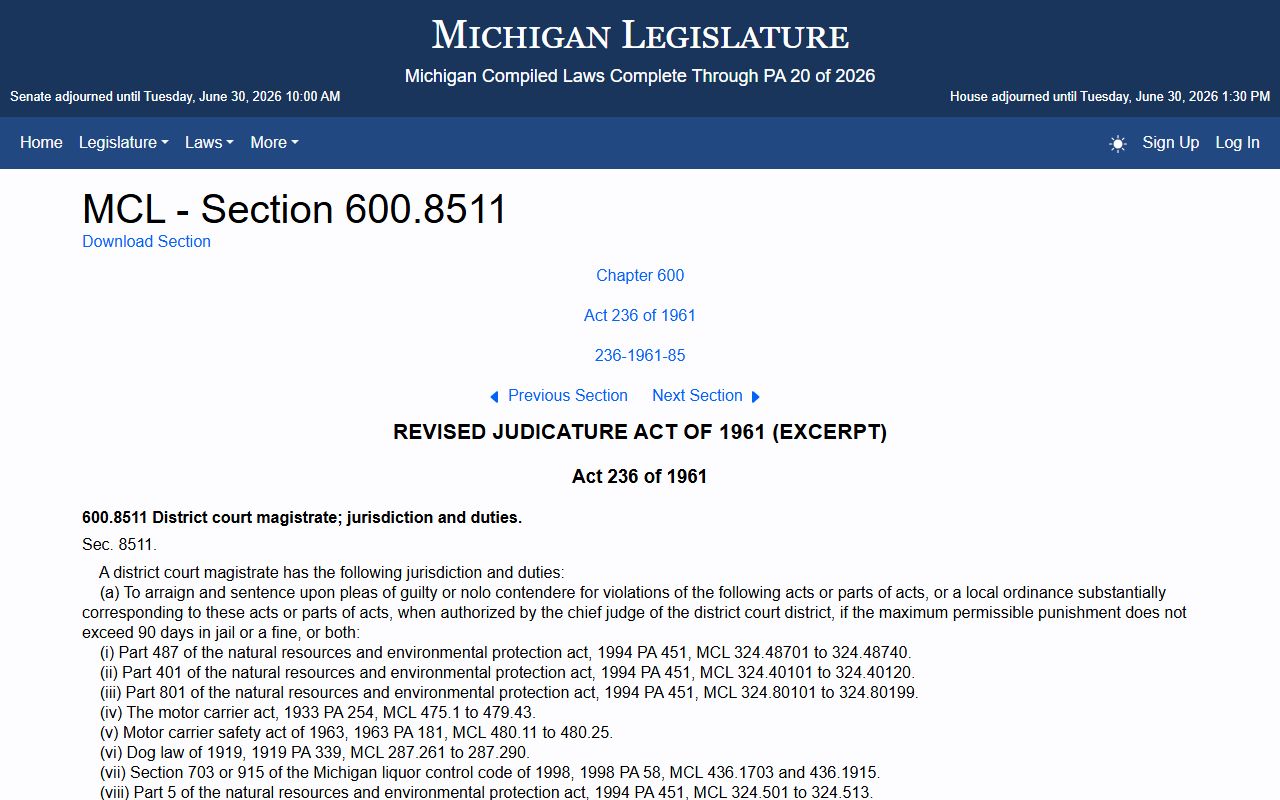
That statute is the backbone for what the magistrate can and cannot decide, and it explains why a felony still has to reach a district judge and then the circuit court. The probate court fills the third seat. Registrar Ashley Holm sits in Suite 10 with the trial court, and under MCL 600.801 the probate court is its own court of record for wills, estates, guardianships, and conservatorships.
Iron County also runs an adult treatment lane. The adult probation and drug-court function sits in Suite 5 at (906) 875-0117, tied to the district-court side rather than a standalone building. That track focuses on treatment and supervision compliance for eligible defendants, a problem-solving path that steers some cases away from a plain sentence. The county does not publish the program's eligibility rules or graduation figures, so a reader should call the probation line for current terms.
Federal Court for Iron County Cases
Not every Iron County dispute stays in state court. Federal crimes, federal civil-rights suits, and bankruptcy cases go to the United States District Court for the Western District of Michigan, whose Northern Division clerk sits in Marquette. Iron County falls inside that Northern Division, so Marquette is the relevant federal stop for residents, with the Sixth Circuit as the federal appellate court.
Federal records ride on a separate access system from the state circuit court. The court walks new users through the setup in its PACER user manual, which covers how to register before pulling any docket.
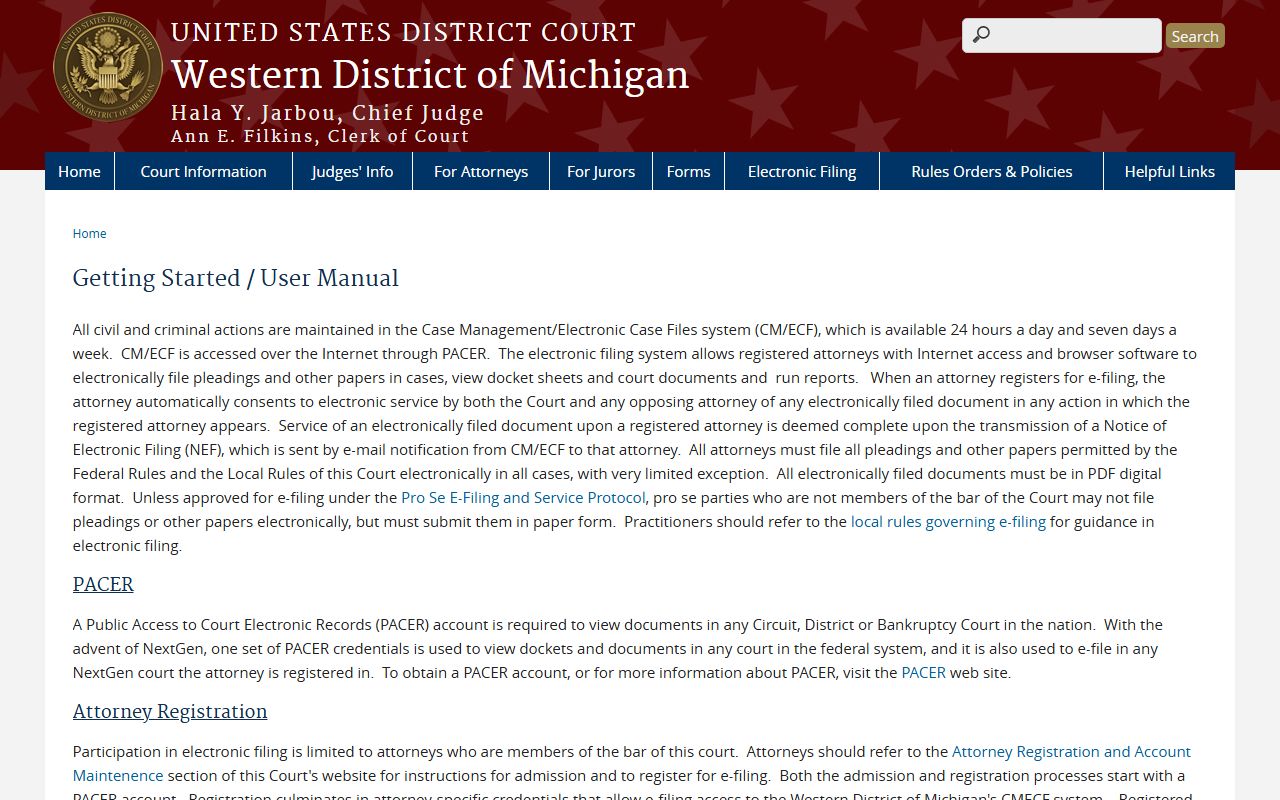
That guide shows why a federal search never runs through MiCOURT: the two systems do not share data. Attorneys who file in the Western District follow a different track, laid out on the court's electronic-filing page.
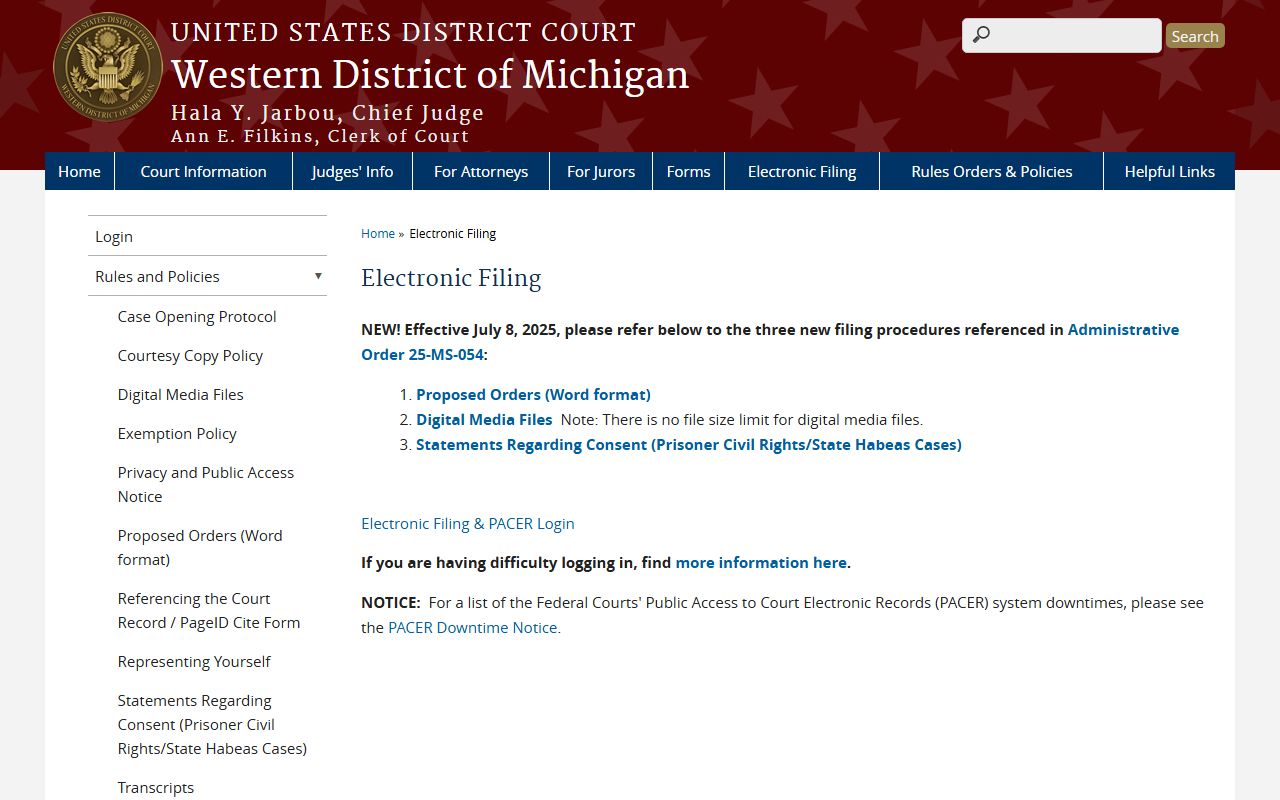
The electronic-filing page is the registration and submission hub for lawyers with federal matters, and it rounds out the picture for anyone whose Iron County case crosses from the state circuit court into the federal system.