
Criminal Court Records in Iron County
A criminal court record is the case file a court opens the moment charges are brought against a person. In Iron County the clerk of court holds that file and logs every event in it, from the first appearance to the closing order. The record is not one page. It is a running docket of charges, hearing dates, motions, orders, and the final outcome. When people ask for a person's Iron County criminal record, they usually mean this court file, which lives with the trial court in Crystal Falls rather than with the police or the jail.
Two trial courts produce these files. The District Court handles misdemeanors punishable by up to one year, ordinance violations, and the early steps of every felony, a role set out in MCL 600.8311. The 41st Circuit Court is the general court of record under MCL 600.601, and it takes a felony once the case is bound over. Because of that split, a single defendant can have a district court file and a circuit court file for the same arrest.
How a Criminal Case Moves Through Iron County Courts
A criminal case does not jump straight to a verdict. It moves through a set order of steps, and each step leaves its own mark in the record. Felonies start in district court for the early hearings, then cross over to circuit court if the evidence holds. Misdemeanors stay in district court from start to finish. Knowing the path helps a reader tell where a file sits and what the next docket entry should be.
Case flow: Charges Filed › Arraignment › Probable-Cause Conference / Preliminary Exam › Bindover to Circuit Court › Pretrial / Motions › Plea or Trial › Disposition › Sentencing
| Stage | What Happens |
|---|---|
| Charges Filed | The prosecutor authorizes a complaint that names the charge and the statute. This opens the case file. |
| Arraignment | The first formal court date. The court reads the charge, sets or reviews bond, and takes an early plea. |
| Probable-Cause Conference | A felony step in district court where the two sides discuss the case and any early resolution. |
| Preliminary Examination | A district court hearing that tests whether there is enough proof to send a felony forward. |
| Bindover | The transfer of a felony from district court to the 41st Circuit Court once the proof holds. |
| Pretrial / Motions | Both sides exchange information and file motions. Plea talks often happen here. |
| Plea or Trial | The case ends in a guilty or no-contest plea, or it goes to a jury or bench trial. |
| Sentencing | After a conviction the judge imposes jail, prison, probation, fines, or restitution. |
How to Search Iron County Criminal Court Records
Iron County does not run its own court case portal. The main online path is the statewide MiCOURT Case Search, which can return civil, traffic, criminal, domestic, and probate cases depending on the court. The public view is an index plus case history, so it shows the docket rather than every filed document. Some courts display a criminal conviction only when sentencing fell within seven years of the search date, so an older case may not surface online.
- Open MiCOURT Case Search and choose the public case-search mode.
- Search by party name if you are looking for a person, or by case number if you already have one.
- Narrow the search by lower court, case type, and date so felony and misdemeanor files sort out.
- Open the matching case to read the docket, the charges, and the disposition.
- Ask the clerk of court for a certified copy when you need a record a court or agency will accept.
The counter and the phone are the fallback when a file is old, sealed from online view, or missing. Circuit court criminal files sit with the clerk of court at (906) 875-3221, and district court criminal and traffic files sit with the district court clerk at (906) 875-0619. For charging questions, the Iron County Prosecuting Attorney in Suite 1 reviews and authorizes felony and misdemeanor charges and can be reached at (906) 875-6628. The Iron County Prosecuting Attorney office page also lists victim services and links to state offender resources.
The prosecuting attorney office page is a useful hub for anyone tracking a charge from filing to outcome.
The office that authorizes the charge sits one door from the courts that record it, which is why the prosecutor is a natural second stop when a case file raises a question about how a charge was filed or amended. When the online index falls short, a records request under the court-record rules or Michigan FOIA is the last route, and it goes to the office that holds the file rather than to the state portal.
What an Iron County Criminal Court Record Shows
A criminal case file is a set of fields, and each one answers a plain question about the case. The state case-search system and Michigan records-management rules give a good map of what appears. A public view leads with the case number, the party names, and the case history, while a full certified file adds the documents behind each docket line. The table below breaks down the fields a reader meets most often.
| Field | What It Shows |
|---|---|
| Case Number | The court's reference number for the file, used to pull it at the counter or online. |
| Court | Whether the file lives in district court or the 41st Circuit Court. |
| Defendant | The person charged, listed with role and any alternate names. |
| Charges | Each count with its description, statute, count number, and disposition. |
| Plea | Guilty, not guilty, or no contest entered on the charge. |
| Hearings | Scheduled dates, times, and hearing types across the case. |
| Bond | Bond type and amount, plus any forfeiture or release data. |
| Disposition | The result of each charge, from dismissal to conviction. |
| Sentence | Jail, prison, probation, fines, or restitution imposed after a conviction. |
| Attorney | Counsel of record for the defense where one appears. |
Sensitive fields are kept out of the public view. Social Security numbers, financial-account numbers, minor names, and sealed juvenile data are redacted or hidden under court rule, which is why a public docket and a complete case file are not the same thing.
Reading Iron County Dispositions and Sentences
The disposition is the payoff line of a criminal record. It tells you how a charge ended, and the sentence tells you what followed a conviction. One case can carry several dispositions when it holds several counts, so read each charge on its own rather than the case as a whole. The common outcomes fall into a short list.
- Guilty plea: The defendant admits the charge and skips trial.
- No contest: The defendant does not fight the charge but does not admit it.
- Convicted at trial: A jury or judge finds guilt after a trial.
- Not guilty: A trial ends in acquittal on the charge.
- Dismissed: The court drops the charge, sometimes as part of a plea deal.
- Reduced: A charge is amended down to a lesser offense before disposition.
A sentence entry spells out the punishment. It can list jail time in the county lockup, a prison term under state custody, a term of probation, fines, court costs, or restitution paid to a victim. Probation and restitution often generate their own docket lines for months after sentencing, so an active file may keep updating long after the plea.
Charges vs. Convictions
Being charged is not the same as being convicted. A criminal court record can show a charge that was dropped, dismissed, or that ended in acquittal, and that charge still appears in the file even though it led nowhere. Reading a record well means checking the disposition next to each charge rather than stopping at the accusation. The comparison below sets the two apart.
| Charge | Conviction | |
|---|---|---|
| Stage | Accusation filed by the prosecutor | Verdict or plea entered by the court |
| Burden of Proof | Probable cause | Beyond a reasonable doubt |
| Can Change | Amended, reduced, or dropped | Stands unless appealed or set aside |
| Public Record | Yes | Yes |
The charges themselves, from the complaint through any amendment, are covered in more depth on the Iron County arrest records and court charges page, while this file focuses on the case from arraignment through sentence.
Public Access to Iron County Criminal Court Records
Adult criminal case files in Michigan are open records by default. The court-record access rule and the state open-records law both point the same way: a record is public unless a statute or court rule closes it. For county administrative files the backup route is a FOIA request, while the courts run under their own court-record rule, so the clerk counter and the FOIA office are not the same channel.
Key Statutes:
Michigan Compiled Laws § 15.231 - The state Freedom of Information Act says public records are open unless a statute says otherwise.
Michigan Court Rule 8.119(H) - Requests for public court records follow the court-record access rule, not FOIA alone.
Note: Some courts show a criminal conviction on the state portal only when sentencing occurred within seven years of the search date, so an older case may need a counter request.
Sealed, Expunged, and Set-Aside Records
Michigan gives two ways to pull a conviction out of ordinary public view: an automatic Clean Slate expungement once a waiting period runs, and a petition-based set aside a person files themselves. A set aside removes a conviction from the public record, but the underlying entry may survive in nonpublic law-enforcement systems. No page should promise that a case can be erased, because a set-aside conviction is hidden, not deleted.
| Sealed | Expunged / Set Aside | |
|---|---|---|
| Visibility | Hidden from public view | Removed from public view as if set aside |
| Law Enforcement | Limited access remains | Nonpublic copy may still exist |
| How It Happens | Court order on a specific file | Automatic Clean Slate or an MC 227 petition |
| Driving Record | May stay visible | Reportable convictions stay on the driving record |
The petition route runs through the convicting court. A person files an MC 227 Application to Set Aside Conviction in the court that entered the conviction, then mails copies of the packet to the Michigan Attorney General and to the prosecutor where the conviction happened. Certified copies of the convictions go in the packet, and the clerk may charge for those. For many applications the court waits on a Michigan State Police report before it acts. If the prosecutor does not object, the court can enter the order setting the conviction aside.
The Michigan State Police Clean Slate page explains which convictions expunge on their own and when, and it is the best starting point before filing anything.
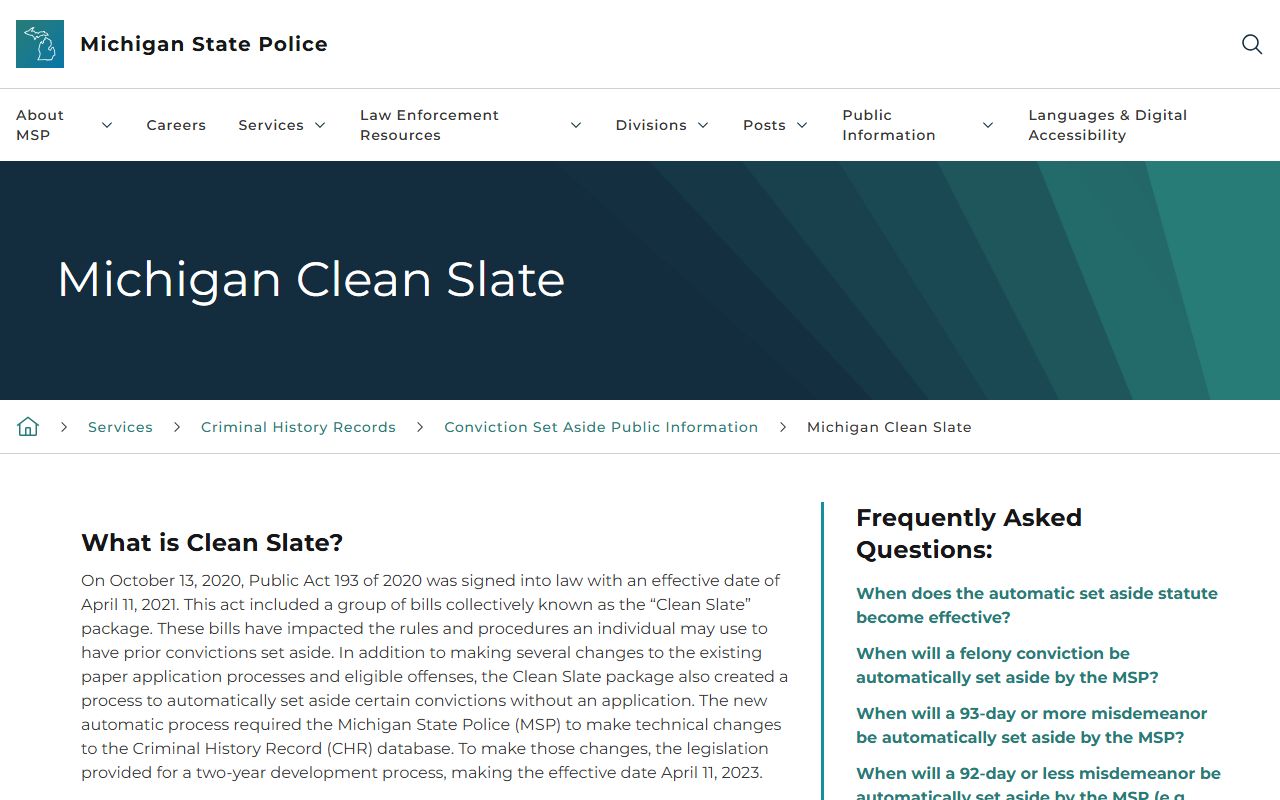
The state overview also flags the driving-record caveat, since a conviction reportable to the Secretary of State stays on the driving record even after a set aside. Free help with the paperwork is available through the Attorney General expungement assistance program, which runs clinics across the state.
Restricted Criminal Court Records in Iron County
Not every criminal matter is open. Juvenile delinquency records are the clearest example. Under MCL 712A.28, juvenile case records are not open to the general public and are released only by court order to someone with a legitimate interest. Iron County runs a juvenile register and a juvenile probation office in Suite 22, so these cases are handled locally, but the public cannot search them like an adult file.
Other files narrow the same way. Sealed and set-aside cases drop off the public index, adoption and mental-health commitment matters carry their own access limits, and even an open case can have fields redacted. An ongoing matter may also show a thin docket because sensitive filings stay sealed until the case closes. When a file will not open online, the counter, the prosecutor, or a records request is the route to confirm what exists.
Background Check Considerations
Reading a case file for curiosity is not the same as running a background check for a job or a lease. A formal check must follow the Fair Credit Reporting Act, use a regulated screening firm, and give the subject a chance to respond. A casual look at Iron County court records or the state portal does not meet that standard and should not stand in for it. For a full criminal history the Michigan State Police record check is the proper source, and the court file fills in the case-level detail behind any single case.
Important: Iron County Court Records is not an FCRA-regulated consumer reporting agency, and its information may not be used to decide credit, employment, housing, or insurance.