
How to Search Iron County Traffic Court Records
Iron County does not run its own traffic citation website. The main online route is the statewide MiCOURT Case Search, which lets you look for a case by number, party name, or lower court when the district court has published it. Traffic tickets are filed as district court cases here, so a visible file will show the charge, the hearing date, the balance, and the final result. Not every ticket appears online, and older or recently written citations may not be posted yet.
Before you start, gather what you have. The citation number from the ticket is the fastest key. A driver name and date of birth help when you do not have the ticket in hand. A driver license number is useful for matching the right person when names are common. If the case is not online, the district court clerk in Suite 5 can confirm the details by phone at (906) 875-0619.
- Open the statewide MiCOURT Case Search and choose the case-search option.
- Enter the citation or case number, or search by driver name.
- Filter by lower court and pick the Iron County district court when prompted.
- Open the matching case to read the charge, court date, and disposition.
- Pay online, contest the ticket, or ask the clerk for a certified copy.
Which Courts Handle Traffic Cases in Iron County
Michigan runs three trial courts: circuit, district, and probate. Traffic matters land in the district court, and the county payment page confirms this by separating District Court tickets from circuit court felony files. A speeding ticket, a stop-sign violation, or a seat-belt citation is a district court case from start to finish. Only when a traffic event becomes part of a wider criminal case does it touch the circuit court lane.
The district court clerk handles the file and the fines. A magistrate can take pleas, hold informal hearings, and manage many traffic duties under state law. The trial court line routes callers to the right desk when they are unsure. Every one of these offices sits inside the same courthouse complex in Crystal Falls.
| Office | Traffic Role | Phone |
|---|---|---|
| District Court Clerk, Suite 5 | Ticket filing, payments, case records | (906) 875-0619 |
| Magistrate, Suite 5 | Pleas, informal hearings, traffic duties | (906) 875-0618 |
| Trial Court / District Court | General routing and hearing questions | (906) 875-0659 |
Types of Iron County Traffic Cases on Record
Traffic files cover a wide range of driving offenses. Most are civil infractions that carry a fine and, in some cases, points. A smaller group are misdemeanors that can bring jail time and a criminal record. The record you find depends on the offense written on the citation.
- Moving violations - Speeding, careless driving, failure to yield, and similar infractions that add points.
- Non-moving violations - Registration, insurance, and equipment problems that do not usually add points.
- Parking citations - Local parking tickets, often handled by the issuing municipality rather than the court.
- Commercial vehicle offenses - Violations tied to a commercial driver license carry stricter rules and federal reporting.
- Serious misdemeanors - Driving on a suspended license, reckless driving, and impaired driving move toward the criminal side.
What Iron County Traffic Court Records Show
A traffic case file reads much like any other court record, with fields for the parties, the charge, and the outcome. The public online view is usually an index plus a case history, not a full downloadable file. The clerk keeps the complete file at the counter. The fields below are the ones most drivers look for when they pull an Iron County traffic record.
| Field | What It Shows |
|---|---|
| Citation / Case Number | The court reference used to track the ticket |
| Charge / Statute | The violation cited and the law or ordinance it falls under |
| Court Date | The hearing or appearance date set by the district court |
| Disposition | The result, such as paid, dismissed, guilty, or reduced |
| Balance | Fines, costs, and any amount still owed |
| Case Status | Open, closed, or transferred within the system |
Note: the public docket view redacts sensitive fields such as license and account numbers, so it is an index and history rather than a complete copy of the file.
Searching by Case Number vs by Name
The case number is the cleanest way to find one ticket, since it points to a single file. Searching by name is broader and can return several people who share it, so a date of birth helps narrow the list. Format errors are the most common reason a search fails, so copy the citation number exactly as it appears. The statewide search offers the fields below.
| Search Field | Type | Required | Notes / Format |
|---|---|---|---|
| Case / Citation Number | Text | No | Enter it exactly, including any letters and leading zeros |
| Party Name | Text | No | Last name first; add a first name to narrow results |
| Lower Court | Menu | Yes | Select the Iron County district court to limit the search |
| Date of Birth | Date | No | Helps match the right person when names repeat |
Paying or Contesting an Iron County Traffic Ticket
The county lets you pay district court fines and costs online or by phone. Its payments page uses pay location code #1375 for district court tickets, and it keeps ticket payments separate from felony-file payments. Pay before the deadline on the citation to avoid added costs or a hold on your license. If you want to fight the ticket instead, do not pay it, because paying is treated as admitting responsibility.
Contesting a ticket means asking for a hearing. A civil infraction can go to an informal hearing before the magistrate, where no lawyer is needed and the officer explains the stop. A formal hearing brings lawyers and stricter rules. For a misdemeanor charge you enter a plea and appear as scheduled. The district court clerk sets the date and explains which hearing type fits your case.
- Read the deadline and the appearance instructions printed on the citation.
- To pay, use the county payments page or call with pay location code #1375.
- To contest, tell the clerk you deny responsibility and ask for a hearing.
- Choose an informal or formal hearing for a civil infraction, or enter a plea for a misdemeanor.
- Appear at the set date, or request a certified record from the clerk afterward.
Court Traffic Record vs State Driver Record
The court traffic record and the state driving record are two different files, and drivers mix them up all the time. The court file is the case the district court clerk keeps: the citation, the court date, the disposition, and the fine. The state driving record is kept by the Secretary of State and shows license history, points, and license status. A conviction can appear in both, but you reach each one a different way.
The Michigan Secretary of State explains the driving record on its driving record service page, where a certified copy can be bought online after you create and verify a MiLogin account. The screenshot below shows that state service.
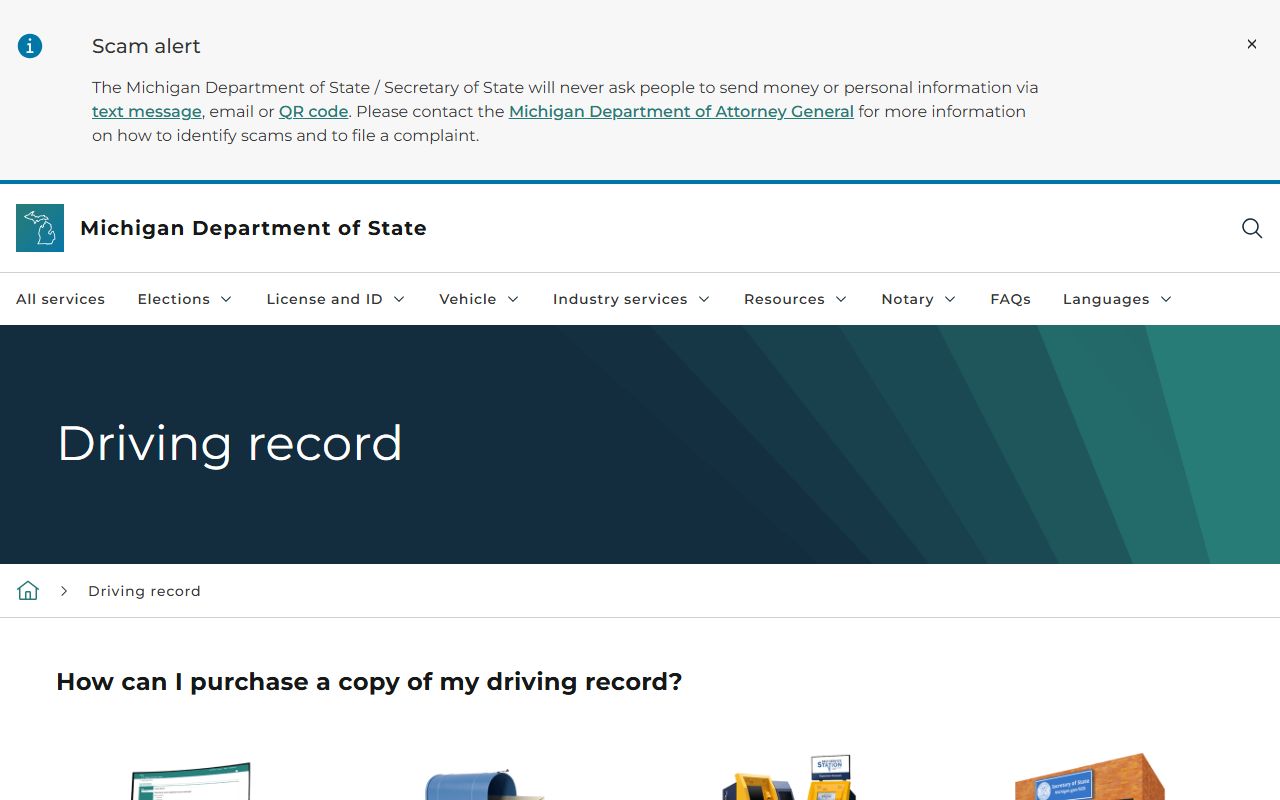
That online record stays visible for seven days after purchase, which is why it is a separate lookup and not just a copy of the district court docket. The comparison below lines up the two records side by side.
| Court Traffic Record | State Driver Record | |
|---|---|---|
| Record Source | Iron County district court clerk | Michigan Secretary of State |
| What It Shows | Citation, court date, disposition, fine | License history, points, license status |
| Where to Access | MiCOURT search or the clerk counter | Online with MiLogin, by mail, or at an office |
| How to Correct Errors | Ask the district court clerk to review the file | Contact the Secretary of State about the driving record |
Public Access Laws for Iron County Traffic Records
Most adult traffic files are open records. Michigan opens public records by default under its Freedom of Information Act, and court files follow the court-record access rules. Driver information carries extra privacy protection under federal law, which the state applies when it releases driving records. The Secretary of State lays out those rules on its driver and vehicle records FAQ.
That FAQ explains who may buy a driving record and how personal details are protected, which matters because a traffic conviction can appear on both the court file and the state record. The statutes below govern access on the court side.
Key Statutes:
Michigan Code § 15.231 - The Freedom of Information Act keeps public records open unless a statute says otherwise.
Michigan Code § 600.8311 - District court handles misdemeanors, ordinance violations, and related traffic matters.
Michigan Code § 600.8511 - District court magistrates may handle limited arraignment and traffic duties.
CDL and Commercial Driver Records
Commercial driver license holders face tighter rules than other drivers. Many violations that a regular driver could resolve quietly must be reported and can affect the commercial license even when the citation happens in a personal car. That federal reporting duty is why a CDL holder should treat a traffic ticket seriously and check the driving record after the case closes. Employers who run driver records in bulk use the Secretary of State business resources for account-based access.
Those business tools let carriers and account holders pull records for hiring and safety review under the state privacy rules. A commercial driver who wants to keep a clean record should confirm each ticket in Iron County was resolved correctly in the district court file.
DUI and OWI Cases in Iron County
Impaired driving is not an ordinary traffic ticket. In Michigan an operating-while-intoxicated charge is a criminal matter that can start in the district court and move to the circuit court on more serious counts. These cases carry jail exposure, license action, and a criminal record, so they are tracked as criminal files rather than simple citations.
For the full case file, charges, and sentencing, see the Iron County criminal court records. The traffic docket alone will not show the whole picture on an impaired-driving case.
Deferred Resolutions and Defensive Driving
Some drivers ask the court to reduce a charge or keep points off the record. In Michigan this is usually handled through a plea agreement with the prosecutor or through the magistrate at an informal hearing, not through a formal defensive-driving diversion program like some states run. A reduced charge can lower the points that reach the state driving record, though the court still records what actually happened.
Whether a reduction is offered depends on the driving history and the offense. The district court clerk and the magistrate can explain the options for a specific citation. Any deal reached still shows in the court file as the final disposition.
Sealing or Expunging Iron County Traffic Records
Michigan has both petition-based set-aside relief and automatic Clean Slate relief for qualifying convictions. A misdemeanor traffic conviction may become eligible to be set aside once a waiting period passes, and some convictions clear automatically. A set-aside removes a conviction from ordinary public view, but the underlying record can still exist in nonpublic systems. No one should promise a driver that a case can simply be erased.
There is an important limit for drivers. Convictions reportable to the Secretary of State keep affecting the driving record even after the court sets the conviction aside, so the driving history is not expunged along with the court file. A petition is filed in the convicting court, with copies mailed to the Michigan Attorney General and the prosecutor, and certified copies of the conviction are required.
Important: Even when a conviction is set aside, a traffic offense reportable to the Secretary of State can remain on the state driving record.
Fees for Traffic and Driving Records
Two different offices charge for records, so the cost depends on which file you need. The Secretary of State sets clear prices for the driving record, listed on its service page. The district court clerk charges its own copy and certification fees for the court file, and certified copies cost more than plain ones. The Secretary of State also sells a vehicle history report when you need title and registration background rather than a driver record.
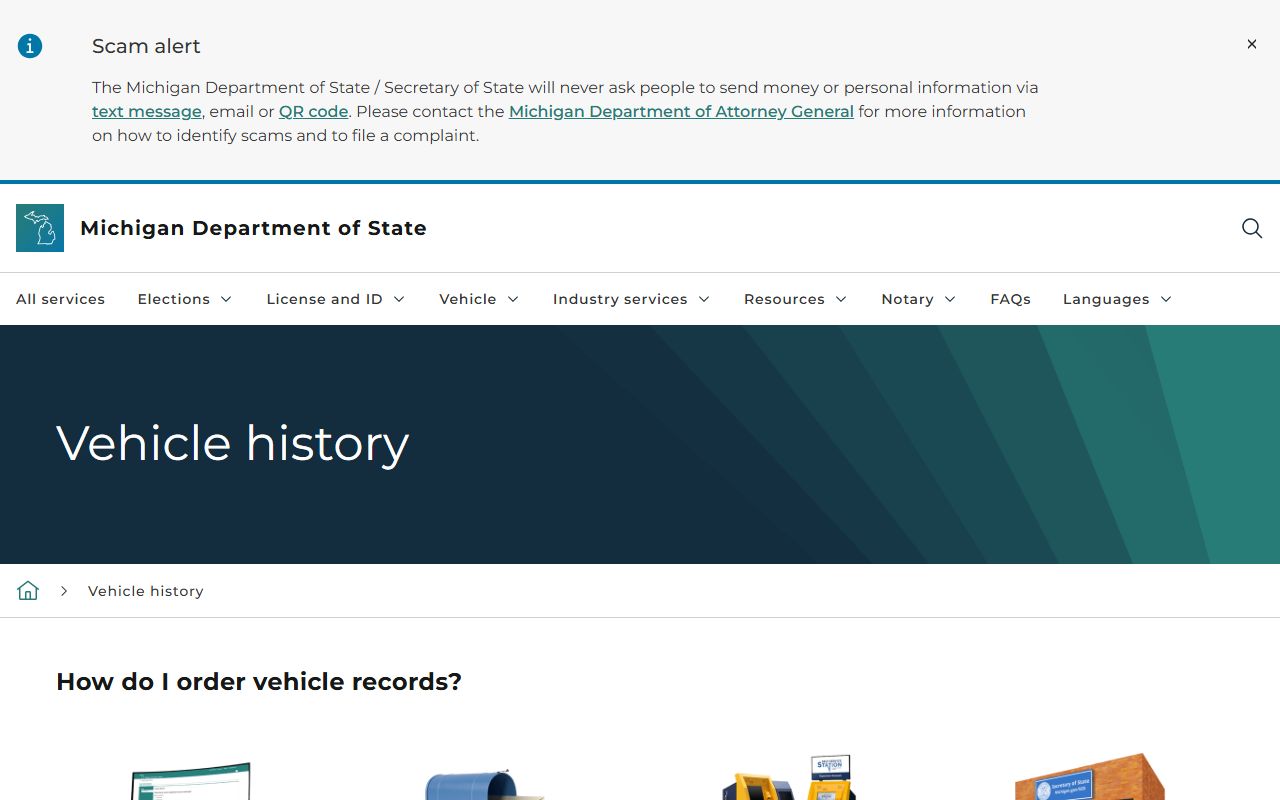
That vehicle history service is separate from both the court traffic file and the driving record, so match the report to the question you are trying to answer. The state driving-record fees are set below; for court copy fees, ask the clerk, since local copy charges are set at the counter.
| Item | Amount |
|---|---|
| Driving record, online certified | $16 |
| Driving record, mail copy | $15 |
| Driving record, mail certified | $16 |
| Court copy and certification | Ask the district court clerk |